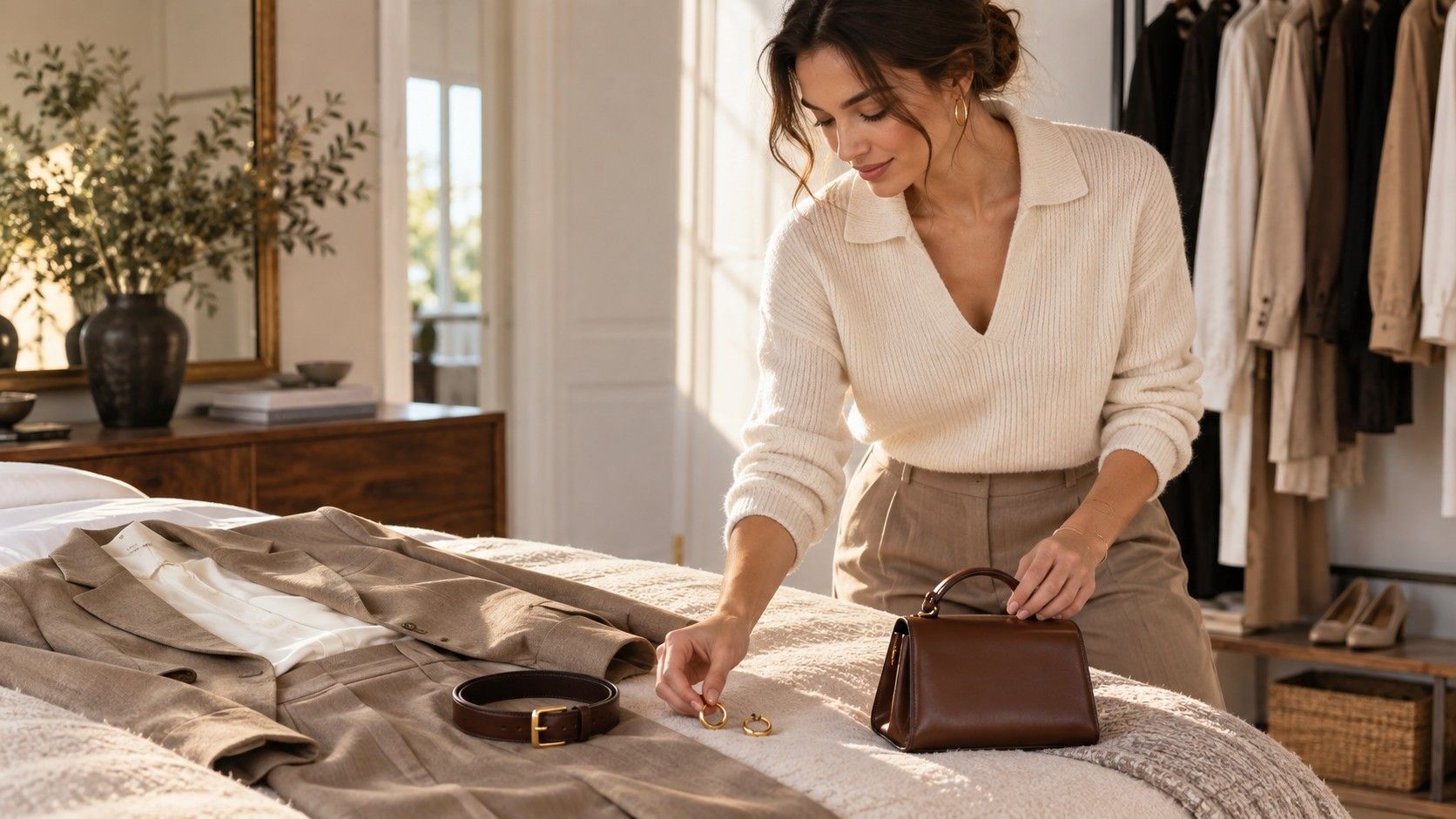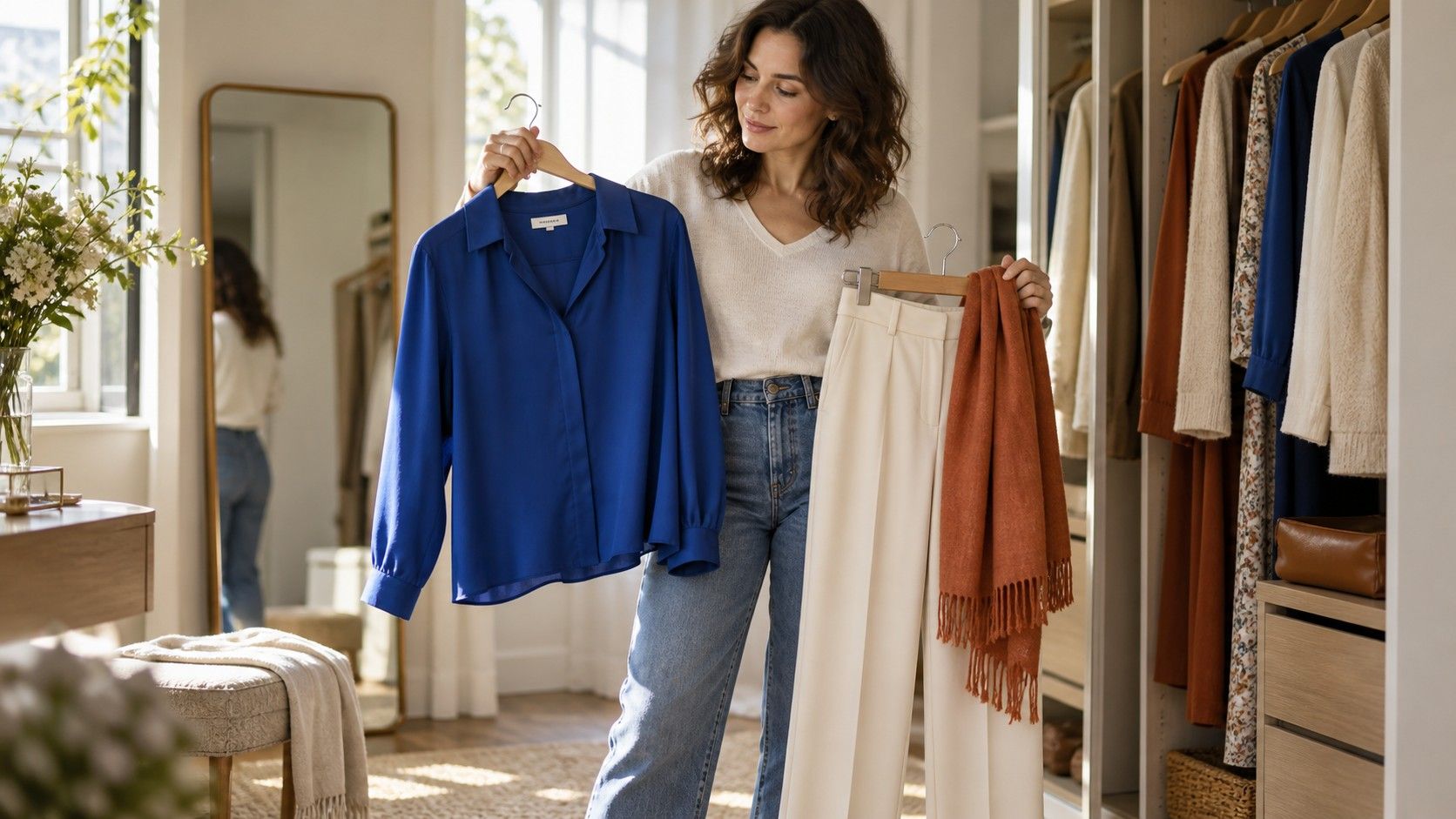
Everyday outfit formulas are not uniforms in disguise. They are a handful of dependable starting points that remove the empty-closet feeling when you have clothes but no clear combination. The best formulas leave room for weather, mood, and personality. They simply take care of the first decision, so you are not asking every shirt in the wardrobe to become an original idea at 7:40 a.m.
Why formulas make ordinary mornings easier
Decision fatigue is real in a practical sense: the more small choices you make before leaving home, the more likely you are to default to something uncomfortable or abandon a good outfit halfway through. A formula gives you a repeatable structure such as fitted top plus fuller bottom plus simple shoe, or relaxed bottom plus shaped layer plus clean sneaker. You still choose the colors and fabrics, but the proportion problem has already been solved.
Use a top-and-bottom framework first
Start with outfits you have worn successfully, not looks saved from people with different weather, jobs, or bodies. A photo album on your phone can become a better source of everyday outfit ideas than an endless feed. Save the combinations that survived the day: the trousers did not crease badly, the jacket fit over the bag, and the shoes did not become a punishment after lunch. Those are the formulas worth repeating.
Add a third piece when the outfit needs structure
The simplest formula is a clear top and bottom with a deliberate difference in shape. Straight jeans with a closer tee, wide-leg trousers with a tucked or shorter knit, or a relaxed shirt with a slimmer column underneath all create balance. You do not have to follow strict body-type rules. Just avoid making every element equally oversized or equally tight unless that is a silhouette you consciously enjoy.
Pay attention to where the top ends. A long boxy sweater over wide-leg trousers can shorten the visible leg line, while a partial tuck, a shorter layer, or a higher waist can restore shape. With jeans, the same sweater may look easy because the denim gives more structure. Try the outfit in a full-length mirror and take one photo. The camera often shows proportion more plainly than the close-up mirror view.
A third piece is simply a layer that changes the outline: an overshirt, cardigan, blazer, denim jacket, chore coat, or lightweight trench. It is especially useful when a tee and jeans feel unfinished but you do not want to look overdressed. An open overshirt adds vertical lines and pockets; a cardigan softens the outfit; a jacket gives the shoulders more definition. The right layer often does more than another accessory.
Keep the third piece compatible with how you move through the day. A stiff blazer may work for a desk day but lose the battle with a packed commute. An overshirt should fit over your common sleeves and still close if the temperature drops. Test layers with the bag you actually carry. A strap can bunch a soft cardigan or drag a blazer out of shape, which is a small detail that makes an otherwise good formula feel irritating by noon.
Change the shoes to change the message
Footwear is the quickest way to shift an outfit formula without rebuilding it. Jeans, a knit, and an overshirt become more casual with running-style sneakers, more grounded with boots, and more polished with a loafer or simple leather shoe. The clothes have not changed, but the weight and finish at the bottom of the look have. This is useful when you need one outfit to travel from errands to a casual dinner.
Match the shoe to the trouser hem before relying on the formula. Wide-leg trousers often need a shoe with enough visual presence that it does not vanish beneath the fabric. Cropped straight jeans can handle a low sneaker or loafer well. If a shoe makes every trouser length look awkward, it may be a fine shoe with a very limited job. Outfit formulas work best when footwear is part of the starting equation, not an emergency choice at the door.
Use color repetition to make simple clothes look intentional
A formula can look considered with only two or three colors. Repeat one color in a small way: navy trousers with a navy stripe in the shirt, brown boots with a brown belt, or a green knit with a small green detail in a scarf. The repetition does not need to be exact. Related shades are usually less rigid and more natural than matching every item to a paint sample.
When you want more color, make one item the focal point and let the rest stay calm. A red cardigan with denim and cream, a patterned shirt under a navy jacket, or cobalt shoes with otherwise neutral clothes is easier to wear than several competing accents. This approach also makes what to wear everyday more manageable: you know where the visual energy belongs before you start adding pieces out of indecision.
Keep a formula library that belongs to you
Write down five or six combinations in plain language: dark jeans plus tee plus overshirt plus boots; wide-leg trousers plus fitted knit plus loafer; straight trouser plus shirt plus cardigan plus sneaker. Leave blank spaces for color and season. A formula should be adaptable enough to work with your actual laundry cycle and temperature, not a one-time costume that needs every item cleaned at once.
Review the library after a few weeks. If you never wear a formula, find the practical reason: perhaps the layer is too warm, the neckline is wrong, or the shoes make walking unpleasant. Adjust one element rather than abandoning the idea. The aim is not to make every day look identical. It is to have a few dependable roads through the closet, leaving your attention free for the days when you genuinely want to experiment.
| Formula | Best for | Easy variation |
|---|---|---|
| Jeans + tee + overshirt + boots | Errands and casual evenings | Swap boots for clean sneakers |
| Wide-leg trousers + fitted knit + loafer | Work or lunch plans | Add a cardigan instead of a jacket |
| Straight trousers + shirt + soft layer | Office days with changing temperature | Use a tee under an open shirt |
| Denim + knit + structured jacket | When you want more polish | Change the jacket for a chore coat |