Mixing patterns in outfits becomes much less mysterious once you stop treating every print as a statement piece. A striped shirt, checked trousers, a floral scarf, and a leopard shoe all have a job: they create rhythm, contrast, or a point of focus. The useful question is not whether two prints are allowed together. It is whether the eye has a clear place to land and whether the clothes still feel like something you would wear on an ordinary Tuesday.
Start with one pattern you already trust
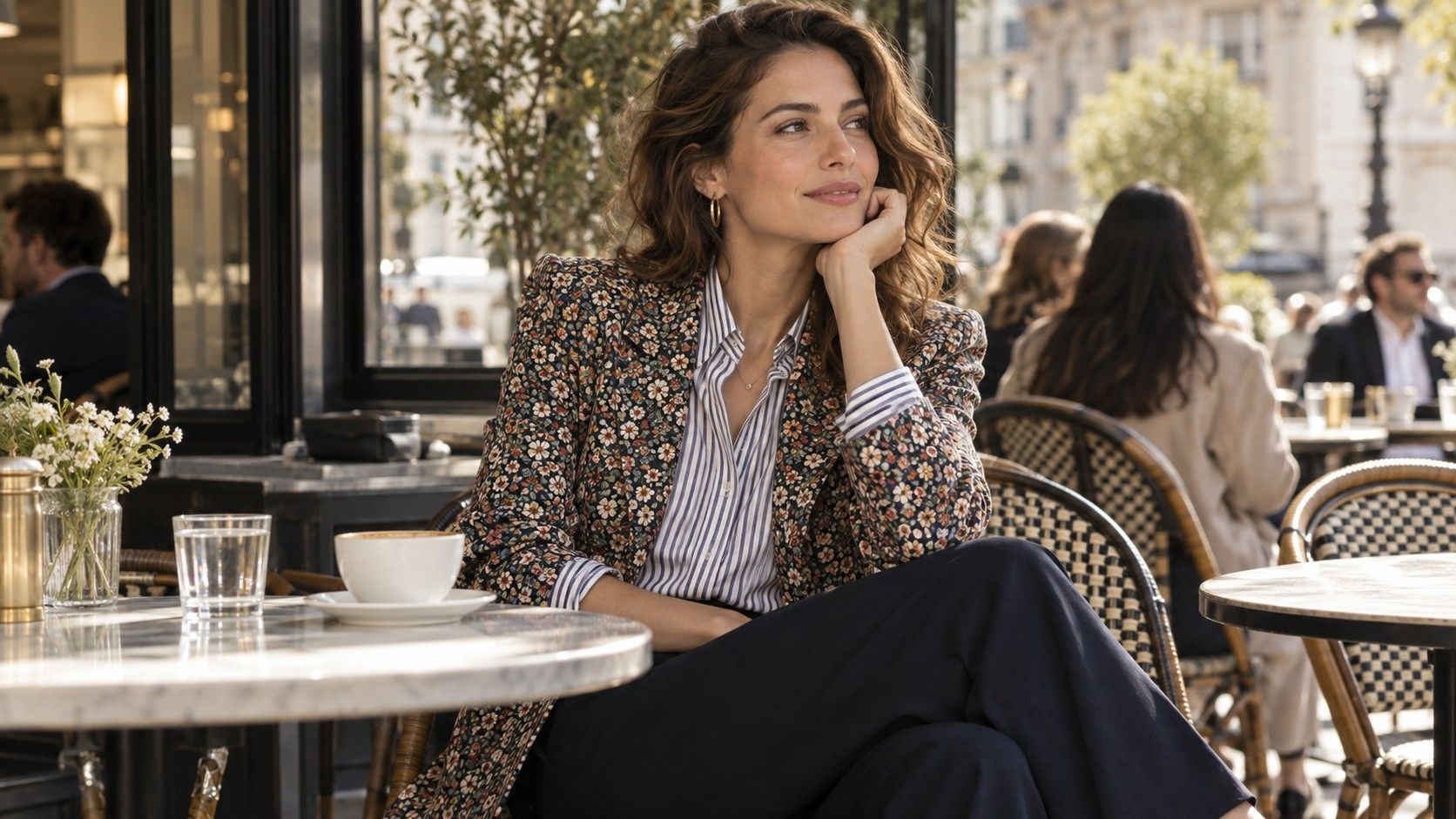
The easiest answer to how to mix prints is to begin with a familiar anchor. That might be a navy-and-cream Breton stripe, a small gingham shirt, or a black-and-white polka-dot skirt. Wear it first with the solid pieces you normally choose, then replace only one solid with a second pattern. This keeps the experiment small enough that you can see what changed. A striped top under a checked blazer often works because the colors are restrained, while a floral blouse with a tiny dotted scarf can feel calmer than two large, high-contrast motifs.
Use scale so the patterns do not shout at the same time
Think of the first print as the piece that sets the volume. If it is bold, graphic, or spread across a large coat, let the second print be quieter: smaller dots, a thin pinstripe, or a bag with a subtle weave. If the first print is a fine neutral check, it can tolerate a more visible partner. Taking a quick mirror photo helps here. In motion, a combination may feel lively; in a still image, you can spot whether the prints compete around the face.
Find one color connection before adding a third piece
Scale is the most reliable tool in print outfit ideas. Pair one larger pattern with one smaller one: wide stripes with a fine floral, a broad plaid with tiny spots, or a bold animal-print belt against a narrow ribbed stripe. When both prints have the same size and density, the outfit can look busy even if the colors match. The problem is not confidence; it is that neither pattern gives the other any breathing room.
Look at the distance from which the print reads. A micro-check may register as texture from across a room, while a large flower reads as a picture. Those are different roles and they can sit together easily. Two medium-sized checks often need more separation, such as a plain knit between them. The same idea applies to accessories: a small patterned sock can be the second print because it occupies little visual space, whereas printed trousers already fill most of the lower half of the outfit.
A color link makes unlike patterns feel intentional. It does not need to be an exact match. A rust detail in a floral skirt can echo the warm brown in a checked jacket; pale blue stripes can connect to the background of a scarf. Choose one shared color and let the rest of the palette differ. This is more convincing than forcing every item into the same shade, which can make separate prints look like an accidental set.
Neutral prints are especially useful when you are learning. Black-and-white stripes, tan-and-cream checks, and navy dots behave almost like solids, so they leave room for a colored floral or abstract print. If both pieces are colorful, reduce the number of colors elsewhere. A plain shoe and bag can keep the color story readable. Before leaving, check the outfit in daylight: indoor lighting can hide a clash between cool grey, bright white, and cream that becomes obvious outside.
Create breathing room with solids and texture
Solids are not a failure of nerve; they are the pauses that make mixed prints legible. A plain denim jacket between a patterned dress and striped knit, or a simple black belt between printed top and skirt, breaks the outfit into manageable areas. A solid also gives you a place to repeat a color from one print without adding another motif. This is why a blazer, cardigan, or opaque tights can make a combination suddenly feel finished.
Texture can play the role of a quiet print too. Denim, suede, cable knit, linen, and leather bring surface interest without asking for attention in the same way as florals or checks. A silky floral blouse with matte wool trousers has enough contrast even before a patterned accessory arrives. When an outfit seems flat, try texture first; when it seems noisy, remove a print before removing all personality. The goal is a layered look, not a matching-game result.
Know when to edit rather than add
A mixed-print outfit should still make dressing easier, not turn into a puzzle you revisit all day. If you keep adjusting the scarf, wondering about the shoes, or adding jewelry to make the combination make sense, take one item away. Often the better outfit has two prints, one strong accessory, and a simple base. A third print can work, but it usually needs a clear reason: a small striped sock repeating the shirt color, or a printed bag that contains the same tones already present.
Use a short edit test before you leave: step back several feet, cover one printed item with your hand, then ask whether the outfit loses something useful or simply becomes quieter. If it only becomes quieter, you have found an optional extra. Over time, save photos of combinations that felt comfortable for a full day. They become your personal reference for mixing patterns in outfits, which is far more useful than memorising rigid rules about stripes, florals, or leopard print.
There is also a practical question of confidence. Wear a new pairing first on a low-stakes day, not when you need to feel invisible or are already late. Notice whether you forget about it after an hour. If you do, it is probably working. If you keep looking down to check it, simplify the colors or use the second pattern in a smaller place. Personal style grows from combinations that can survive ordinary movement, weather, and a full schedule.
Keep a small record of the combinations that succeed. A photo with notes such as “thin stripe plus small floral, tan shoes” is more useful than vague memory. Soon you will see a few dependable formulas: one pattern close to the face, another below the waist; a neutral stripe with a colored print; or two quiet motifs with one solid layer. Those formulas make adventurous dressing repeatable rather than random.